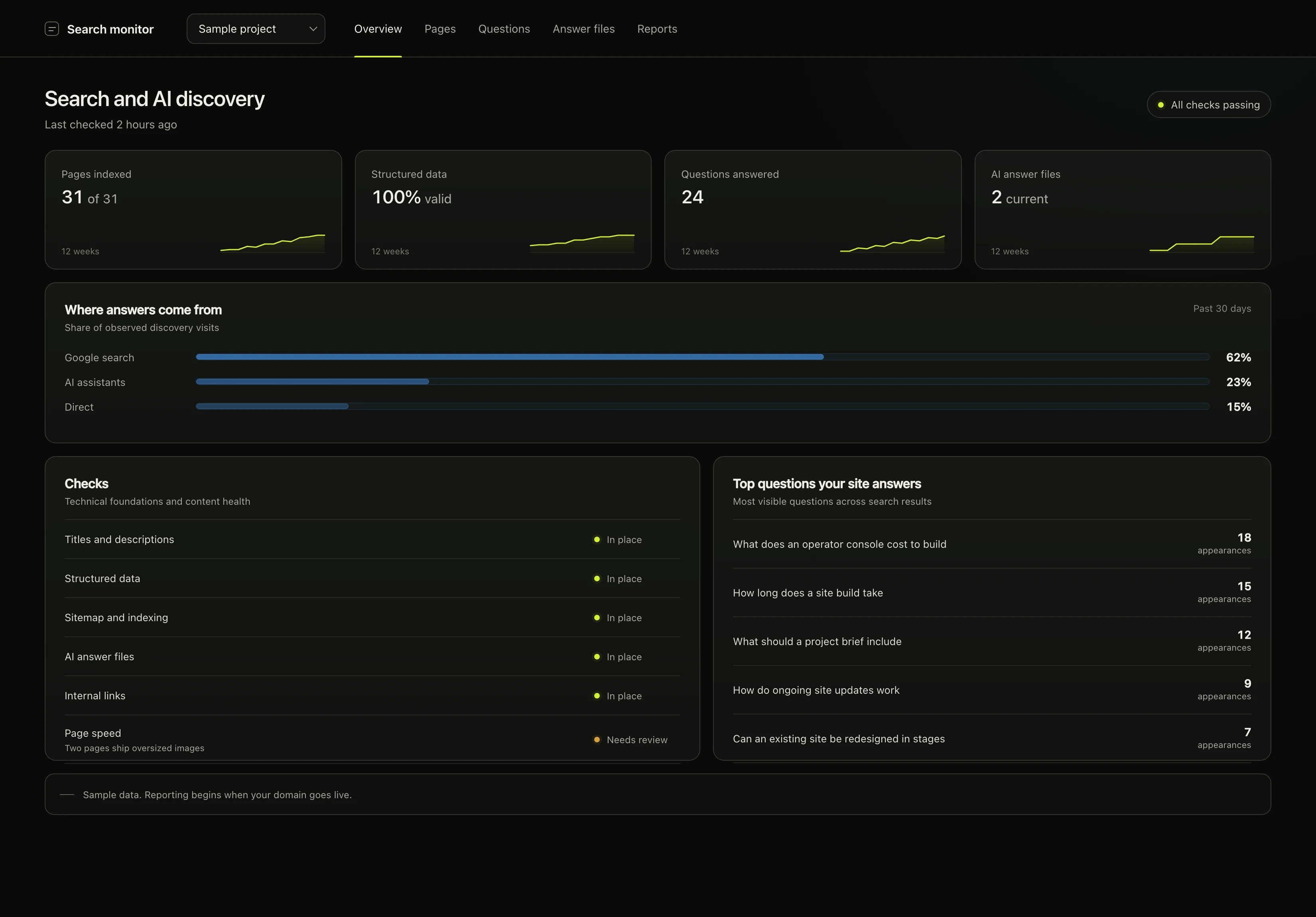
Maximize a website for AI search by assigning each buyer question to one page, answering it directly in visible HTML, and stating every supported fact the same way across the site. Align the title, description, headings, structured data, canonical URL, internal links, sitemap, discovery files, and answer files with that visible answer.
An AI-search page needs enough context to stand on its own. A clear sentence buried inside a vague page gives an engine almost nothing. The same sentence on a focused, accessible, internally linked page gives people and engines a source worth quoting.
Pages built this way give ChatGPT, Gemini, and Google's AI answer surfaces cleaner material to interpret and quote. Each engine still decides which sources it uses and how it presents them. Anyone who tells you otherwise is selling something.
The work starts with the facts the business can support. Page structure and machine-readable fields carry those facts. They cannot invent them.
Build a fact map before changing pages
List the facts buyers need before they choose you: the offer, who it is for, deliverables, process, boundaries, source material, rights, and the next action. Record where each fact comes from inside the business.
Write one approved version of each fact and use it everywhere: home page, service pages, guides, metadata, structured data, profiles, answer files. Every conflicting sentence hands an engine two versions of your business to pick between, and you don't get a vote on which one it picks.
Keep an implementation record with these fields:
- Approved fact
- Source inside the business
- Primary page
- Other pages that repeat or support it
- Metadata and structured-data fields that use it
- Review date and reviewer
When the offer changes, this record is how you find every surface that has to change with it.

Give each buyer question one primary page
Write down the questions buyers actually ask, in their words. Assign each question to the one page that can answer it completely. A service question lives on the service page. A process question lives on the method page. A question about a finished piece lives with its work record.
Give the primary page a clear purpose. Title, H1, opening answer, section headings, and next action all serve the same question. Related pages link to it with text that says what it is.
One page can hold several closely related questions. Split it when the questions serve different intentions or need different evidence.
Keyframe0's website work covers route planning, message hierarchy, page copy, responsive implementation, and the connected lead path.
Put the direct answer in visible HTML
Put a short answer near the top of the page, in complete sentences that name the subject. Write it so it stays accurate when an engine lifts it away from the page, because that is exactly what an engine will do with it.
A useful answer block contains:
- The subject or business being described
- The direct answer to the buyer question
- The condition or boundary that changes the answer
- A supported next step when one helps the reader
Then follow it with the evidence and detail a buyer needs: inputs, decisions, deliverables, limitations, and who owns the next action.
Keep the essential copy in server-rendered HTML. Text that only exists in an image, a video frame, a canvas, a hover state, or a client-only interface is a weaker source. Load the page with scripts disabled and check that its purpose, answer, navigation, and next action are still there.
Make the metadata answer the same question
Write a distinct title and description for every priority page. The title names the subject and the question the page resolves. The description states the answer or what the reader gets out of the page.
Match the H1 to the same purpose. Point the canonical URL at the version you want treated as primary. Kill or consolidate duplicate pages making the same claim in different words.
Metadata is the engine's compact description of your page. Make it summarize what is actually there. A description that promises what the body never delivers reads as noise to people and machines both.
Match structured data to visible facts
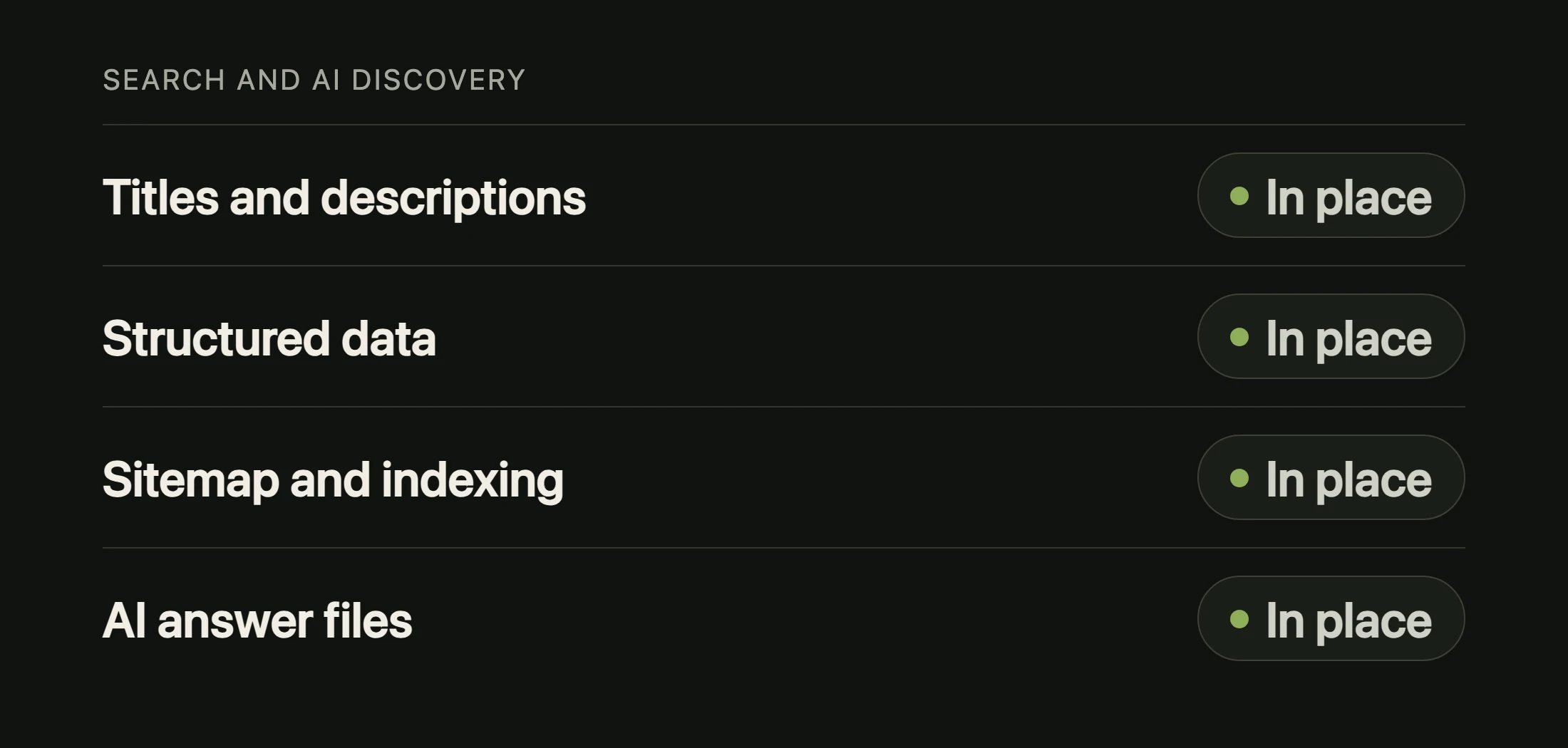
Choose structured data that describes the page's real content and fill the useful fields with information visible on the page. An article carries its headline, description, canonical page, organization author, organization publisher, approved dates, and approved image. A service page describes a supported service and its provider.
Structured data never gets to introduce a client, result, award, review, date, service, or business detail the reader cannot verify on the visible page. Validate the markup, then compare it line by line with the copy before publishing.
Structured data gives machines labels and relationships. The visible page is the evidence those labels describe. Keep it in that order.
Maintain discovery and answer surfaces
Discovery files help crawlers find pages and understand access rules. Keep the sitemap current, include the canonical pages that matter, and clear out blocked, duplicate, test, and retired routes. Re-check crawler access rules whenever hosting or route structure changes.
Answer files can give machines a compact summary plus links to the detailed pages. The proposed llms.txt file is one example. Clean text or Markdown versions of complex material serve the same purpose when you keep them accurate.
Treat every answer file as an index to visible evidence: a concise supported description, priority topics, canonical links, and a short line on what each destination covers. Keep private material, unsupported claims, promotional filler, and copied page text out of it.
No special file can force an engine to quote you. Standard page access, useful visible content, accurate metadata, and matching structured data are the foundation, and there is no shortcut around them.
Connect the pages with descriptive links
Internal links show how broad pages, detailed guides, work records, and the intake path relate. Use link text that names the destination. "AI-search implementation" tells a reader and an engine something. "Learn more" tells them nothing.
Every priority page should be reachable through ordinary links. Hunt for orphaned pages after a launch or route change, and update the sitemap, answer files, canonical references, and implementation record in the same pass.
Keyframe0's SEO and AI-search work covers the supported fact map, question-and-answer map, visible answers, structured data, discovery files, metadata, internal links, and written implementation record.
Run a page-level quote test
Read the direct answer without the heading or the rest of the page. If it still identifies the subject and answers the question accurately, it passes. Then compare it against the title, description, structured data, canonical URL, internal links, sitemap entry, and answer-file summary.
Check the same fact across every owned page that states it. Fix contradictions at the source and record the approved wording. Repeat the check when the offer, page structure, or business facts change.
All of this improves the quality and consistency of the source. Ranking, traffic, and selection in an AI answer stay outside any studio's control. Nobody honest sells those.
For a free written review of how your site presents its answers, send the web address through Work with us.